Actual date of this event: 1 November
Our visit to the Berlin Wall Memorial was one of our favorite activities in Berlin. It isn't very "exciting" per se, but we were really interested in learning more about the division in Berlin and East Germany. I openly admit that the only thing I knew about the Berlin Wall was that there
was a wall. I openly admit that I had zero clue as to why it was built and its purpose prior to this trip. We did quite a bit of reading, loads of learning, and it was all very worth our time! I'm all knowledgeable and stuff now...
not quite.
The best station for accessing the Berlin Wall Memorial is the S-Bahn Nordbahnhof. When the division began, this station became a ghost station (trains did not stop at it) since it was located in East Berlin. The memorial is directly outside of the station making the attraction super easy to spot!
Before the visit, I had no idea that two walls were built, so at first I was very confused with what I was looking at. In the picture above, you can see the posts on left which shows the border wall for East Berlin and the posts on the right (going toward the center of the picture with gravel behind them) which shows the inner wall for West Berlin. The area in between was called the Death Strip. The ground in this area was covered with sand and gravel so guards could easily spot trespassers. Now, the Death Strip of this area of Berlin is where the Memorial is located.


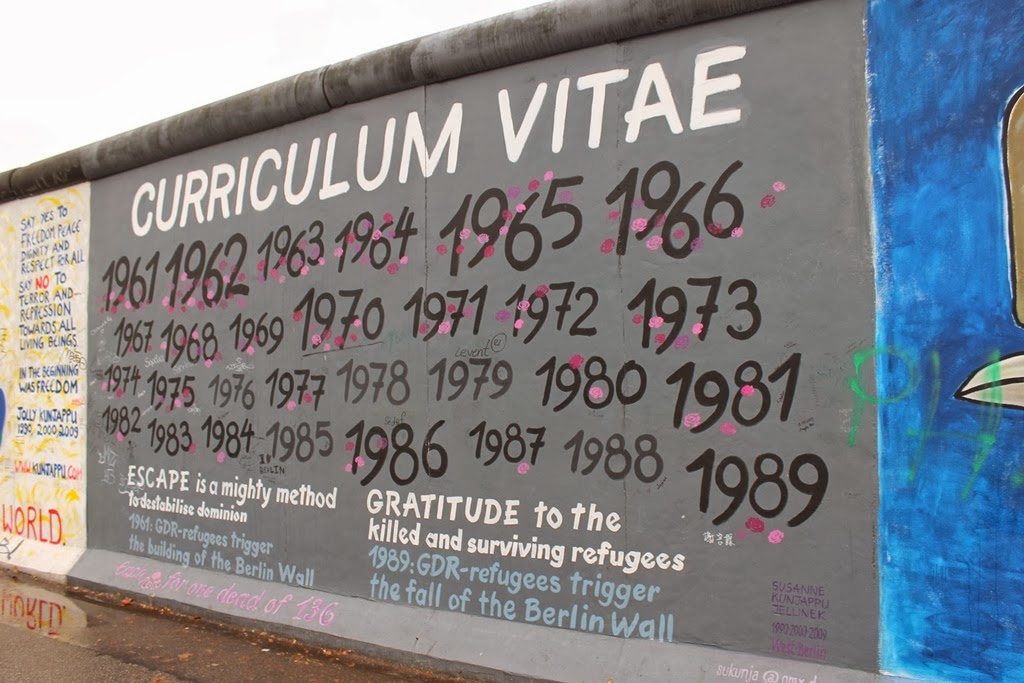
For those of you that are just as clueless as I was, the wall was built by the German Democratic Republic (DDR) in 1961 due to the massive amount of East Germans emigrating to West Berlin. Many people who lived in the east wanted the Soviets (who occupied East Germany after WWII) to leave and also to have access to Western Europe. The DDR was having major issues preventing the emigration thus the wall was built with strict border control.


We learned of a few interesting facts in this section of the 87 mile long wall. A road called Bergstrasse is the only road that was blocked by the wall, and even today it is still not considered a road. Also, this area of the wall was built on a part of a graveyard which was the home of several World War II bomb victims. Many of the headstones were destroyed, and rather than restoring the graveyard, it was decided to build this memorial. A cross has been placed on the ground to commemorate these victims. Sophien Parish removed a few blocks of the wall that were on top of some burials and placed them all in a single area.
The memorial is quite long and is broken up into a few sections along the way.
During the time when the wall was erect, 136 people died - 98 were fugitives fleeing to West Berlin.
Along the way, two steel walls block off an area that is in its original state when the wall was in tact. The tower is original along with the lights. You can sneak some views inside by peaking through the cracks on the wall, but the other side has a viewing platform across the road which is much easier (for whatever reason, we did not go up). Google Maps satellite view shows this area somewhat clearly.
When the walls were built, a church became vacant as it sat in the border strip. It was torn down , but markings on the ground show where it was located.
When the inner wall was built, a few apartment dwellings had to be torn down. People were forced to relocate and choose between East and West Berlin. The foundation of an apartment building is visible and well marked. Display signs tell stories of the difficult choices these people had to make. Also in this section of the memorial, the ground is marked with hashes that show where escape tunnels were located. Many East Berliners were able to escape through the sewage pipes with help from West Berliners.
All along the memorial, large pictures are displayed to show the area in 1961 and 1990. It was really interesting to see those two pictures and then also compare them to what it looks like today.
At the end of the memorial, posts show where a watch tower used to stand on Brunnenstrasse.
It was determined 24 years ago tomorrow, that the East and West could pass through the wall "freely" which started a, once again, unified Germany. The history of Berlin never interested me when I was in school which is why I knew nothing about it prior to this trip. I really enjoyed learning about something that happened in my lifetime, though!
Other posts on Berlin: Intro, Post 2, Wall Memorial, East Side Gallery, Post 5, Ritter Sport Chocolate, Post 7, Post 8, Sachsenhausen Concentration Camp
RANDOM FACT:
The Berlin barricade began as barbed wire that laid on the ground.
 Click here to learn how to comment using Disqus.